
PureTech Presents New Data from Phase 2b Open-Label Extension Study of Deupirfenidone (LYT-100), Further Supporting Strong and Durable Efficacy and Potential to Serve as New Standard of Care in IPF

PureTech Presents New Data from Phase 2b Open-Label Extension Study of Deupirfenidone (LYT-100), Further Supporting Strong and Durable Efficacy and Potential to Serve as New Standard of Care in IPF
Patients who switched from placebo or pirfenidone to deupirfenidone in the open-label extension study achieved stabilization of lung function with favorable tolerability
Findings further substantiate safety and efficacy results from the randomized, placebo- and active-controlled 26-week trial and highlight opportunity to address patients inadequately served by current therapies
Regulatory engagement underway; update on Phase 3 trial design expected in Q4 2025
"The blinded portion of the ELEVATE trial challenged the perspective that the biggest opportunity for new therapies in IPF is improved safety, by showing that treatment with deupirfenidone 825 mg three times a day can achieve lung function stabilization with favorable tolerability. The initial 52-week extension data then raised the bar by demonstrating that this effect with deupirfenidone was durable," said Argyrios E. Tzouvelekis, M.D., Ph.D.,
ELEVATE IPF, a global, randomized, double-blind, active- and placebo-controlled Phase 2b trial, achieved its primary endpoint and demonstrated a statistically significant and clinically meaningful reduction in lung function decline at 26 weeks with deupirfenidone 825 mg three times a day (TID) compared to placebo (Part A). As previously announced, participants treated with deupirfenidone 825 mg TID experienced a slower rate of lung function decline, as measured by change from baseline of Forced Vital Capacity (FVC), at 26 weeks versus those who were treated with pirfenidone 801 mg TID or placebo (-21.5 mL vs. -51.6 mL vs. -112.5 mL, respectively), with a 91 mL difference between deupirfenidone 825 mg and placebo at 26 weeks. Following the completion of the blinded portion of the trial, 170 participants (more than 90%) enrolled in the OLE (Part B). Those who remained on deupirfenidone 825 mg TID maintained a robust treatment effect and experienced an overall FVC decline of -32.8 mL over the 52-week period,[1] which is similar to the expected natural decline in lung function in healthy older adults over that time (approximately -30.0 mL to -50.0 mL).[2]
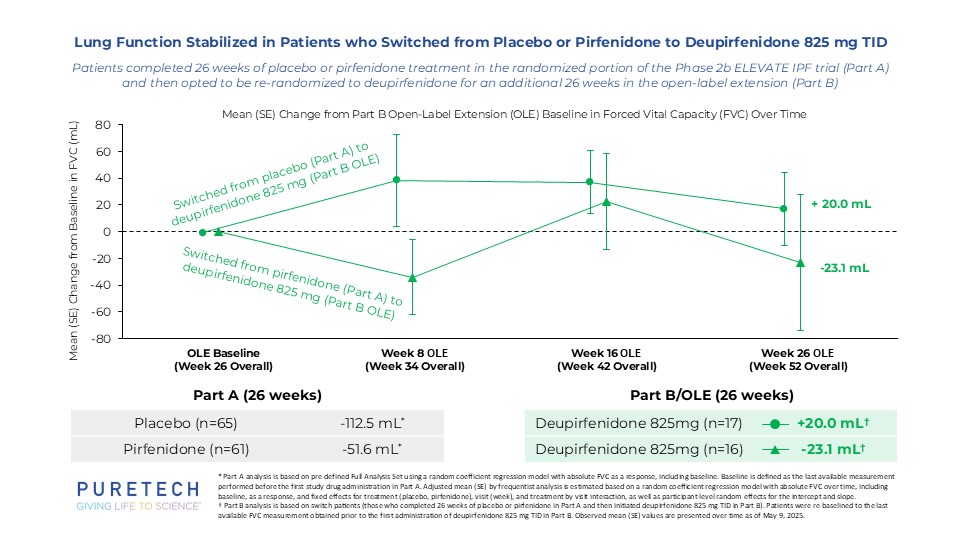
The new results presented at ERS provide additional evidence from participants who initially received placebo or pirfenidone for 26 weeks during Part A and then switched to deupirfenidone for 26 weeks in Part B. Those who switched from placebo to deupirfenidone 825 mg TID (n=17) had a mean change in FVC of +20.0 mL (placebo switch cohort), while those who switched from pirfenidone to deupirfenidone 825 mg TID (n=16) had a mean change in FVC of -23.1 mL (pirfenidone switch cohort).[3] These results provide further evidence from two additional patient cohorts that deupirfenidone may stabilize the decline in lung function to that expected of healthy older adults and suggest a potential benefit for patients transitioning from standard of care to deupirfenidone.
Deupirfenidone continued to be well tolerated at both doses studied in Part B after six months of treatment, and the safety profile remained consistent with Part A. Additional analyses shared at ERS included a summary of the most common treatment-emergent adverse events (TEAEs) in the OLE, defined as occurring in at least 10% of participants in either treatment group. As of
"The ELEVATE trial has been designed and executed to provide one of the most rigorous Phase 2 evaluations of a potential therapy in IPF," said
About Deupirfenidone (LYT-100)
Deupirfenidone (LYT-100) is in development as a potential new standard of care for the treatment of idiopathic pulmonary fibrosis (IPF). It is a deuterated form of pirfenidone, which - along with nintedanib - is one of the two FDA-approved treatments for IPF. Both approved therapies offer only modest efficacy in slowing lung function decline, largely due to tolerability challenges that limit the ability to achieve higher doses that could significantly improve patient outcomes. These limitations have contributed to low treatment uptake and poor adherence, with approximately 25% of people with IPF in the
Deupirfenidone may overcome these limitations. In the global Phase 2b ELEVATE IPF trial, deupirfenidone demonstrated the potential to stabilize lung function decline over at least 26 weeks as a monotherapy while maintaining a favorable safety and tolerability profile. Initial data from an ongoing open-label extension study suggest that this effect may be sustained through at least 52 weeks. These findings support the potential for deupirfenidone to offer a meaningful advance for people living with this progressive and deadly disease. Beyond IPF, deupirfenidone may also address multiple underserved fibrotic conditions, including progressive fibrosing interstitial lung diseases.
About Idiopathic Pulmonary Fibrosis (IPF)
Idiopathic pulmonary fibrosis (IPF) is a rare, progressive, and fatal lung disease characterized by irreversible scarring of lung tissue that leads to a steady decline in lung function. Median survival following diagnosis is estimated to be two to five years, and currently there is no cure.[6]
About Celea Therapeutics
Celea Therapeutics is dedicated to advancing transformative treatments for people with serious respiratory diseases. Drawn from the Latin word for "sky," the name reflects the company's mission to rise above the status quo and deliver therapies that change lives. The company's lead program, deupirfenidone (LYT-100), is a Phase 3-ready therapeutic candidate with the potential to set a new standard of care for idiopathic pulmonary fibrosis (IPF) and other fibrotic lung diseases.
Celea was founded by
About
For more information, visit www.puretechhealth.com or connect with us on X (formerly Twitter) @puretechh.
Cautionary Note Regarding Forward-Looking Statements
This press release contains statements that are or may be forward-looking statements within the meaning of the Private Securities Litigation Reform Act of 1995. All statements contained in this press release that do not relate to matters of historical fact should be considered forward-looking statements, including without limitation statements that relate to continued development of and regulatory interactions related to deupirfenidone, the potential of deupirfenidone in IPF and other indications, our expectations around our therapeutic candidates and approach towards addressing major diseases, our plans to advance our programs and deliver on our milestones, our future plans, prospects, developments, and strategies. The forward-looking statements are based on current expectations and are subject to known and unknown risks, uncertainties and other important factors that could cause actual results, performance and achievements to differ materially from current expectations, including, but not limited to, those risks, uncertainties and other important factors described under the caption "Risk Factors" in our Annual Report on Form 20-F for the year ended
Public Relations
publicrelations@puretechhealth.com
Investor Relations
IR@puretechhealth.com
+44 (0) 20 3727 1000
puretech@fticonsulting.com
US Media
jchen@tenbridgecommunications.com
[1] Integrated analysis of double-blind (26 weeks) and initial open-label extension data from Phase 2b ELEVATE IPF trial as of
[2] Valenzuela, C., Bonella, F., Moor, C., Weimann, G., Miede, C., Stowasser, S., & Maher, T. (2024, September). Decline in forced vital capacity (FVC) in subjects with idiopathic pulmonary fibrosis (IPF) and progressive pulmonary fibrosis (PPF) compared with healthy references [Poster presentation].
[3] Part B analysis is based on switch patients (those who completed 26 weeks of placebo or pirfenidone in Part A and then were re-randomized to receive deupirfenidone 825 mg TID in Part B). Patients were re-baselined to the last available FVC measurement obtained prior to the first administration of deupirfenidone 825 mg TID in Part B. Observed mean (SE) values are presented over time as of
[4] Dempsey, T. M., Payne, S., Sangaralingham, L., Yao, X., Shah, N. D., & Limper, A. H. (2021). Adoption of the antifibrotic medications pirfenidone and nintedanib for patients with idiopathic pulmonary fibrosis. Annals of the
[5] Esbriet peak sales (2020) per Roche 2021 Financial Results & Ofev peak sales (2024) per
[6] Fisher, M., Nathan, S. D., Hill, C., Marshall, J.,
RNS may use your IP address to confirm compliance with the terms and conditions, to analyse how you engage with the information contained in this communication, and to share such analysis on an anonymised basis with others as part of our commercial services. For further information about how RNS and the
END
NRAEAXNKADSSEFA